KS1 English Quiz: Abbreviations (Mr., Mrs.) | Key Stage 1
Build confidence with Abbreviations (Mr., Mrs.) through a KS1 English quiz designed for focused practice, quick revision and simple progress checks.
Overview
- - Improve speed
- - Build confidence
- - Prepare for assessments
Quiz details
Topic: Abbreviations Mr Mrs
Questions: 10
Duration: 10 min
Difficulty: ★★ Medium
Focus: applying Abbreviations Mr Mrs with consistent method and answer precision.
Related Quizzes
Description
Learn how abbreviations like Mr. and Mrs. work in KS1 English
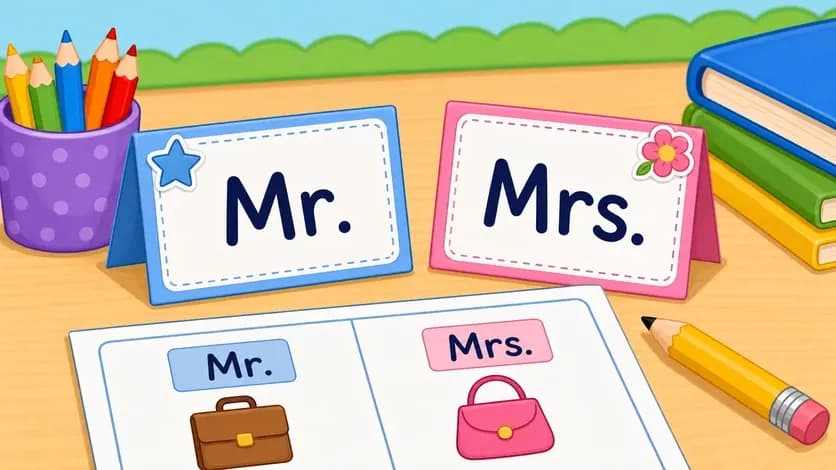
Abbreviations are one of those early English topics that seem small at first but appear everywhere once children start noticing them. In KS1, pupils meet shortened forms in reading books, classroom labels, invitations, worksheets and everyday writing. A quiz on abbreviations such as Mr. and Mrs. helps children recognise that written English often uses shorter forms for common titles and that these forms carry meaning.
This matters because early vocabulary growth is not just about learning new words in full. It also includes learning how familiar words and titles appear in real texts. The Department for Education National Curriculum expects pupils in Key Stage 1 to develop accurate spelling, broad reading experience and a growing understanding of written conventions. Abbreviations support all three because they ask children to connect appearance, pronunciation and meaning.
There is also strong evidence that high-quality talk around vocabulary supports literacy development. The Education Endowment Foundation reports that oral language interventions are linked to around 6 additional months of progress on average, while the toolkit also notes that phonics approaches are linked to around 5 additional months. Although this quiz is not a phonics lesson, it sits in the same larger goal of helping children match printed forms to spoken language accurately.
Why this abbreviations quiz is useful
Children often see Mr. and Mrs. before they fully understand what makes them different from ordinary words. A quiz helps because it slows the idea down. Instead of brushing past the title, pupils stop, identify it, and connect it to a person, a purpose and a writing convention. That kind of attention improves reading fluency and written awareness at the same time.
- It helps children recognise common abbreviated titles in context.
- It improves print awareness in everyday reading.
- It encourages careful attention to punctuation and spelling.
- It supports classroom discussion about names, titles and formality.
What pupils should notice
| Example | What it teaches |
|---|---|
| Mr. | A shortened written title used before a man's name |
| Mrs. | A shortened written title pupils often see in school and books |
| Full stop in an abbreviation | Shows that a word has been shortened in writing |
Children become more flexible readers when adults point out how words can change shape in print. Titles and abbreviations are a simple but powerful example of that.
Attributed to a primary literacy specialist.
How to extend learning after the quiz
After finishing the quiz, ask children to find abbreviated titles in storybooks, letters or notices around the classroom. Real examples help the concept stick. You can also compare abbreviations with full words so pupils see that formal writing sometimes uses shorter forms for convenience and convention.
Citations
Department for Education, National Curriculum in England: English programmes of study
Education Endowment Foundation, Teaching and Learning Toolkit: Oral language interventions; Phonics
This quiz gives children a practical introduction to common abbreviations and helps them read everyday English more confidently. Small conventions like these often make a big difference to reading accuracy over time.
Related links: KS1 English quizzes, Capital letters for proper nouns, Book titles
Quiz reviews
Approved reviews are shown publicly on this page. New or updated reviews stay hidden until moderation is complete.
0.0
0 reviews
average rating
Leave a review
Reviews are limited to logged-in users so public ratings stay tied to real accounts and can be moderated cleanly.
Log in to reviewQuiz FAQ
How should I use this KS1 English Quiz: Abbreviations (Mr., Mrs.) | Key Stage 1?
Complete the quiz once under normal timing, review every mistake, then return to the English subject page to try a related quiz while the topic is still fresh.
What should I do after finishing this KS1 English Quiz: Abbreviations (Mr., Mrs.) | Key Stage 1?
Use your score as a signal. If the result is strong, move to another English quiz for wider coverage. If the result is weak, repeat practice in the same subject before switching topics.
Is KS1 English Quiz: Abbreviations (Mr., Mrs.) | Key Stage 1 enough on its own for English revision?
One quiz is useful for diagnosis, but not enough on its own. The strongest approach is to combine this page with other quizzes in English, plus broader revision or past-paper style practice where available.