Adjectives - Comparative and Superlative Fo KS1 Quiz
Use this KS1 English quiz to revisit Adjectives - Comparative and Superlative Forms (er, est) with clear questions for class and home study.
Overview
- - Improve speed
- - Build confidence
- - Prepare for assessments
Quiz details
Topic: Adjectives Adding Er And Est
Questions: 10
Duration: 10 min
Difficulty: ★★ Medium
Focus: applying Adjectives Adding Er And Est with consistent method and answer precision.
Related Quizzes
Description
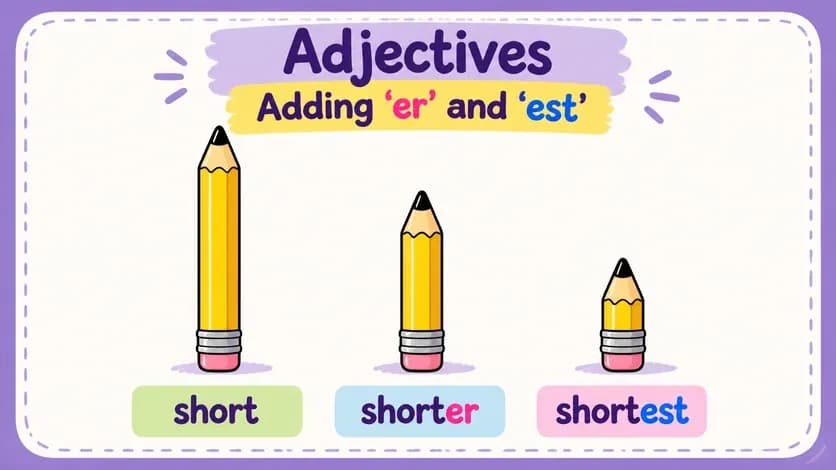
Practise adding er and est to adjectives
Learning how to change adjectives into comparative and superlative forms is an important step in KS1 English. Children already use describing words in speech from an early age, but writing them accurately is different. This quiz helps pupils notice how a simple adjective can change to compare two things or show the strongest example in a group. That small shift supports sentence building, vocabulary growth and confidence in everyday writing.
In the Department for Education National Curriculum, pupils are expected to develop grammatical understanding that helps them speak and write clearly. Work on adjectives fits naturally into that aim because it helps children be more precise. Instead of writing that one object is big, they can say another is bigger and a third is the biggest. That gives their language more control and more purpose.
Short grammar practice can be especially effective when it is paired with feedback. The Education Endowment Foundation toolkit associates feedback with around 6 additional months of progress, and metacognition and self-regulation with around 7 additional months. In practical terms, that means a child benefits most when they answer a question, check it, and think about why the word changed in that specific way.
Why comparatives and superlatives matter
Adding er and est is about more than spelling endings. It teaches children how to compare ideas clearly. These forms appear in stories, classroom talk, simple reports and descriptive sentences. A secure understanding helps pupils read with better comprehension and write with more precision.
- It develops awareness of how adjectives change meaning.
- It supports descriptive writing in KS1.
- It helps children compare size, speed, height and other qualities.
- It reinforces grammar through repeated example-based practice.
What this quiz helps children notice
| Word form | Use in a sentence |
|---|---|
| small | Describes one noun |
| smaller | Compares two nouns |
| smallest | Shows the strongest example in a group |
Grammar grows faster when children can hear the difference, say the difference and then write the difference. Comparative language is a good example of that pattern.
Attributed to a KS1 English lead teacher.
How to extend practice after the quiz
Try asking a child to compare familiar objects at home or in class: a long pencil and a shorter pencil, a tall tower and the tallest tower, a loud drum and a louder one. This turns grammar into something visible and memorable. It also helps children understand that word endings are tied to meaning, not only to spelling rules.
Citations
Department for Education, English programmes of study: key stages 1 and 2
Education Endowment Foundation, Teaching and Learning Toolkit: Feedback; Metacognition and self-regulation
This quiz gives young learners a clear route into comparative and superlative adjectives. Once children are comfortable with er and est, their descriptive writing usually becomes more confident and more exact.
Related links: KS1 English quizzes, Adjectives 1, Adjectives 2
Quiz reviews
Approved reviews are shown publicly on this page. New or updated reviews stay hidden until moderation is complete.
0.0
0 reviews
average rating
Leave a review
Reviews are limited to logged-in users so public ratings stay tied to real accounts and can be moderated cleanly.
Log in to reviewQuiz FAQ
How should I use this Adjectives - Comparative and Superlative Fo KS1 Quiz?
Complete the quiz once under normal timing, review every mistake, then return to the English subject page to try a related quiz while the topic is still fresh.
What should I do after finishing this Adjectives - Comparative and Superlative Fo KS1 Quiz?
Use your score as a signal. If the result is strong, move to another English quiz for wider coverage. If the result is weak, repeat practice in the same subject before switching topics.
Is Adjectives - Comparative and Superlative Fo KS1 Quiz enough on its own for English revision?
One quiz is useful for diagnosis, but not enough on its own. The strongest approach is to combine this page with other quizzes in English, plus broader revision or past-paper style practice where available.