KS1 English Quiz: Adverbs 2 | Key Stage 1
This KS1 English quiz gives pupils a practical way to check Adverbs 2, spot gaps and build confidence before moving on.
Overview
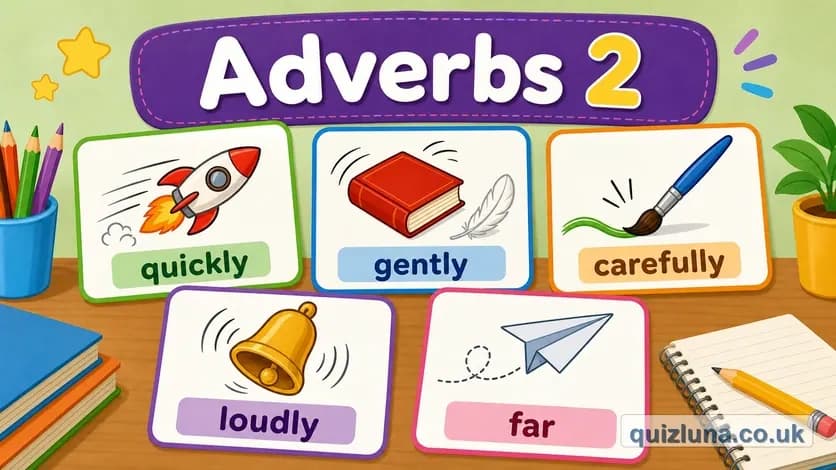
- - Improve speed
- - Build confidence
- - Prepare for assessments
Quiz details
Topic: 2
Questions: 10
Duration: 10 min
Difficulty: ★★ Medium
Focus: applying 2 with consistent method and answer precision.
More on Adverbs
Move sideways through the same text or topic cluster instead of returning to the subject hub each time.
Related Quizzes
Description
Extend sentence detail and control with Adverbs 2
Adverbs become much more useful once children stop seeing them as isolated grammar terms and start seeing how they shape a whole sentence. This second KS1 adverbs quiz gives pupils another chance to practise that idea. By revisiting adverbs in a fresh set of examples, children can become more confident with the language that tells the reader how, when or where something happens.
In practical classroom terms, this is important because sentence expansion is a major part of KS1 writing development. Children are expected to move beyond very short statements and begin adding useful detail. The Department for Education National Curriculum supports this progression through sentence composition, grammar awareness and vocabulary development across Key Stage 1.
Research-backed classroom practice suggests that repeated explanation and review matter. The Education Endowment Foundation toolkit links feedback with around 6 additional months of progress and reading comprehension strategies with around 6 additional months. When a child takes a quiz, checks a mistake, and then compares two sentence versions, they are doing the kind of active review that supports better retention.
Why a second adverbs quiz helps
Children often understand a grammar idea in one setting but struggle to recognise it in another. A second quiz widens the examples and gives more chances to practise without making the task feel overwhelming. This is especially useful for learners who need repetition before a concept feels secure.
- It builds fluency through a new set of adverb examples.
- It helps children notice meaning, not only labels.
- It supports richer sentence work in writing lessons.
- It gives parents and teachers another quick review tool.
How adverbs improve writing quality
| Sentence without an adverb | Sentence with an adverb |
|---|---|
| The bird sang. | The bird sang sweetly. |
| The child ran. | The child ran quickly. |
| The door opened. | The door opened slowly. |
Repeated grammar practice is most effective when children can compare plain sentences with richer ones. That comparison helps them hear what extra words are doing.
Attributed to a primary literacy adviser.
Using this quiz for better revision
One useful approach is to complete the quiz and then ask the child to invent two short sentences of their own using adverbs from memory. This shows whether the knowledge is beginning to transfer into real writing. If the learner can explain the effect of the adverb as well, the understanding is becoming much stronger.
Citations
Department for Education, English programmes of study: key stages 1 and 2
Education Endowment Foundation, Teaching and Learning Toolkit: Feedback; Reading comprehension strategies
Adverbs 2 is a helpful next step for children who are ready to make their writing more expressive. Small improvements in sentence detail often lead to much bigger gains in confidence over time.
Related links: KS1 English quizzes, Adverbs 1, Alliteration
Quiz reviews
Approved reviews are shown publicly on this page. New or updated reviews stay hidden until moderation is complete.
0.0
0 reviews
average rating
Leave a review
Reviews are limited to logged-in users so public ratings stay tied to real accounts and can be moderated cleanly.
Log in to reviewQuiz FAQ
How should I use this KS1 English Quiz: Adverbs 2 | Key Stage 1?
Complete the quiz once under normal timing, review every mistake, then return to the English subject page to try a related quiz while the topic is still fresh.
What should I do after finishing this KS1 English Quiz: Adverbs 2 | Key Stage 1?
Use your score as a signal. If the result is strong, move to another English quiz for wider coverage. If the result is weak, repeat practice in the same subject before switching topics.
Is KS1 English Quiz: Adverbs 2 | Key Stage 1 enough on its own for English revision?
One quiz is useful for diagnosis, but not enough on its own. The strongest approach is to combine this page with other quizzes in English, plus broader revision or past-paper style practice where available.