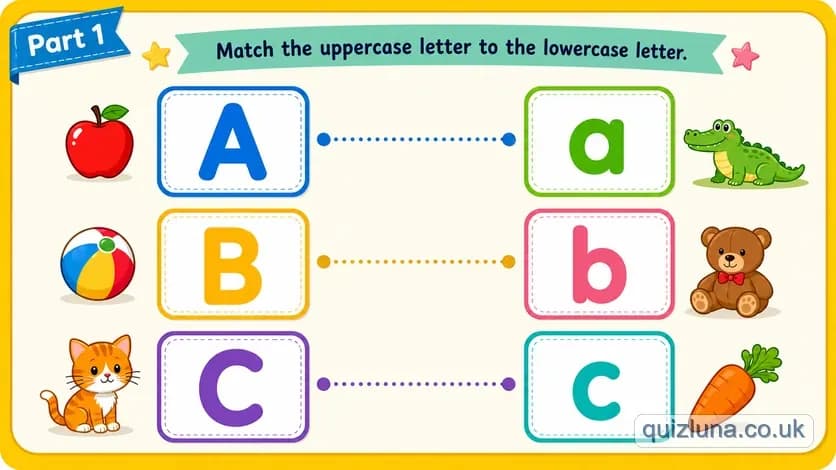
Alphabet - Upper and Lower Case Letters 1 KS1 English Quiz
Support understanding of Alphabet - Upper and Lower Case Letters 1 using a KS1 English quiz with targeted questions for reading, grammar or writing practice.
Overview
- - Improve speed
- - Build confidence
- - Prepare for assessments
Quiz details
Topic: 1
Questions: 10
Duration: 10 min
Difficulty: ★★ Medium
Focus: applying 1 with consistent method and answer precision.
More on Alphabet Upper And Lower Case Letters
Move sideways through the same text or topic cluster instead of returning to the subject hub each time.
Related Quizzes
Description
Practise upper and lower case letters with confidence
Recognising the alphabet in both upper and lower case forms is a core KS1 reading and writing skill. Children meet letters in many different shapes across books, labels, signs, worksheets and digital text. This quiz helps learners become more secure with those forms so that letter recognition feels automatic rather than effortful.
That matters because fluent recognition frees attention for bigger literacy tasks. If a child no longer has to pause over whether a letter is upper case or lower case, they can focus more easily on sounds, words and sentence meaning. The Department for Education National Curriculum expects pupils in Key Stage 1 to develop secure handwriting, spelling and reading foundations, and alphabet knowledge sits underneath all of those areas.
Research also supports careful early literacy teaching. The Education Endowment Foundation reports that phonics approaches are associated with around 5 additional months of progress on average. Oral language interventions are associated with around 6 additional months. A quiz on letter forms fits into that wider early reading picture by helping children match visual symbols accurately and confidently.
Why upper and lower case practice matters
Young children often learn letter names and sounds before they become fully secure with letter forms. Yet printed English uses both upper and lower case constantly. A pupil who can recognise both quickly is better prepared for reading books, writing neatly and using capital letters correctly later on.
- It improves alphabet recognition in real reading situations.
- It supports early spelling and phonics work.
- It prepares children for correct use of capital letters.
- It builds confidence with visual letter patterns.
What this quiz is helping to secure
| Skill | Why it helps |
|---|---|
| Matching cases | Shows that one letter can appear in different forms |
| Alphabet confidence | Makes reading and writing less effortful |
| Visual memory | Supports faster recognition during literacy lessons |
Automatic letter recognition is one of the quiet foundations of literacy. Children often make faster progress once those visual basics feel secure.
Attributed to an early reading practitioner.
How to extend the quiz at home or in class
After completing the quiz, ask the child to point out matching upper and lower case letters in a book, on a poster or on magnetic alphabet pieces. This keeps the learning concrete. You can also sort letter cards into pairs, which helps reinforce the idea that both forms belong to the same letter.
Citations
Department for Education, English programmes of study: key stages 1 and 2
Education Endowment Foundation, Teaching and Learning Toolkit: Phonics; Oral language interventions
This quiz is a practical way to strengthen one of the most basic but most important KS1 English skills. Secure alphabet knowledge makes later reading and writing work much easier to manage.
Related links: KS1 English quizzes, Upper and lower case letters 2, Alphabetical order letters
Quiz reviews
Approved reviews are shown publicly on this page. New or updated reviews stay hidden until moderation is complete.
0.0
0 reviews
average rating
Leave a review
Reviews are limited to logged-in users so public ratings stay tied to real accounts and can be moderated cleanly.
Log in to reviewQuiz FAQ
How should I use this Alphabet - Upper and Lower Case Letters 1 KS1 English Quiz?
Complete the quiz once under normal timing, review every mistake, then return to the English subject page to try a related quiz while the topic is still fresh.
What should I do after finishing this Alphabet - Upper and Lower Case Letters 1 KS1 English Quiz?
Use your score as a signal. If the result is strong, move to another English quiz for wider coverage. If the result is weak, repeat practice in the same subject before switching topics.
Is Alphabet - Upper and Lower Case Letters 1 KS1 English Quiz enough on its own for English revision?
One quiz is useful for diagnosis, but not enough on its own. The strongest approach is to combine this page with other quizzes in English, plus broader revision or past-paper style practice where available.