Grammar as a Design System
A practical 11+ guide to noun phrases, clauses, sentence types, and common errors.
Most students lose marks not because of weak ideas, but because of weak structure. Grammar is not a set of rules to memorise — it is a design system. Once you understand how sentences are built, you gain control over clarity, tone, and precision. That is exactly what 11+ examiners reward.
This guide covers three high-impact areas: building precise noun phrases, understanding phrases and clauses, and avoiding the technical errors that cost marks quickly.
1. Building precise noun phrases
A noun phrase does more than name something — it defines it. Compare a species with a well-known species of snake. Both are correct, but only the second creates a clear picture in the reader's mind. Think of noun phrases as a zoom control: you can stay wide (a building) or zoom in (an old brick building with cracked windows). Skilled writers choose the level deliberately.
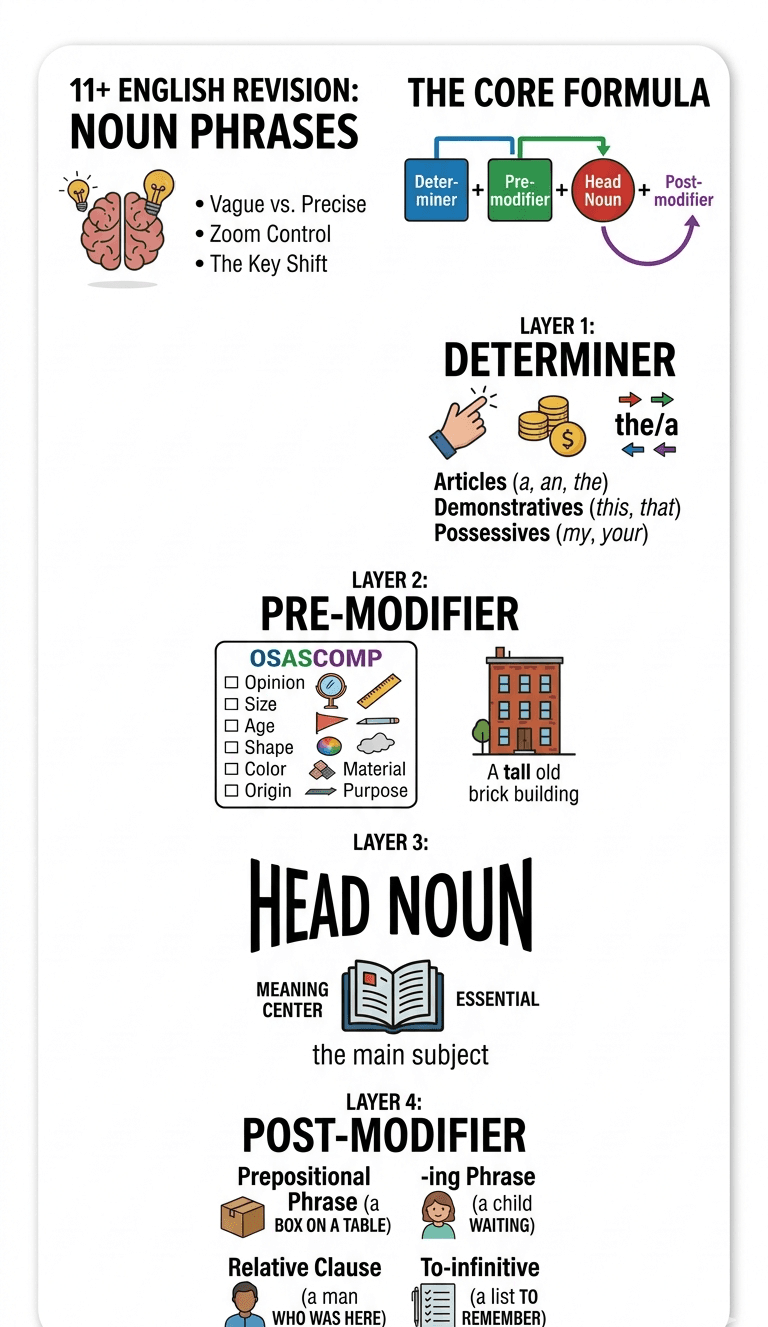
A strong noun phrase follows this order:
Determiner → Pre-modifier → Head noun → Post-modifier
Layer | What it does | Examples |
|---|---|---|
Determiner | Introduces the noun | a, the, my, those, three |
Pre-modifier | Describes before the noun | noisy, broken, small old |
Head noun | The core word | jet, children, gate |
Post-modifier | Expands after the noun | on the table / waiting by the gate / that changed my mind |
When several adjectives appear before a noun, English follows the OSASCOMP order:
Letter | Category | Example |
|---|---|---|
O | Opinion | elegant, ugly |
S | Size | small, huge |
A | Age | old, ancient |
S | Shape | round, square |
C | Colour | silver, dark |
O | Origin | French, Italian |
M | Material | metal, wooden |
P | Purpose | serving, racing |
Example: an elegant small old round silver French metal serving tray
You will rarely use all eight categories at once, but knowing the order prevents awkward-sounding strings of adjectives.
2. Phrases vs clauses
This is one of the most tested distinctions in 11+ grammar.
Definition | Example | |
|---|---|---|
Phrase | A word group with no subject and finite verb | after the storm |
Clause | Contains both a subject and a finite verb | after the storm ended |
Students who confuse these two structures often struggle with punctuation and sentence boundaries.
The full stop test is a fast way to check: find a natural pause, mentally replace the comma with a full stop, and read both parts alone. The part that feels complete is a main clause. The part that feels incomplete is subordinate.
After revising for hours, Maya felt confident.
"After revising for hours." → incomplete — subordinate clause
"Maya felt confident." → complete — main clause
3. The three sentence types
Strong writing uses all three types. Variety creates rhythm and shows the examiner you are in control.
Type | Structure | Example |
|---|---|---|
Simple | One main clause | The fox disappeared. |
Compound | Two main clauses joined by a coordinating conjunction | The fox disappeared, but the dogs kept running. |
Complex | One main clause + one subordinate clause | Although the fox disappeared, the dogs kept running. |
4. Common errors to avoid
Comma splice
A comma splice joins two main clauses with only a comma. Examiners notice this immediately.
Wrong | Correct |
|---|---|
She opened the letter, she burst into tears. | She opened the letter. She burst into tears. |
Apostrophe confusion
Expand the contraction mentally to check: if it is does not fit, do not use it's.
Wrong | Correct | Rule |
|---|---|---|
The dog wagged it's tail. | The dog wagged its tail. | it's = it is · its = belonging to it |
They're bags are over their. | Their bags are over there. | they're = they are · their = belonging · there = place |
I vs me
Use I as a subject and me as an object. Remove the other person to check which is correct.
Wrong | Correct |
|---|---|
The teacher spoke to Tom and I. | The teacher spoke to Tom and me. |
Conclusion
Grammar mastery is not about showing off technical labels. It is about constructing meaning with intention. When you can shape noun phrases, identify clause relationships, and punctuate with purpose, your writing becomes clearer and more persuasive.
For 11+ preparation, this is the real advantage: not memorising isolated rules, but understanding how language works as a system. Once that clicks, you write with confidence instead of guesswork.
Strong writing is engineered. Choose the right building blocks, place them in the right order, and your ideas will stand up under pressure.