What Does KS3 Art and Design Actually Cover?
The national curriculum for Art and Design at Key Stage 3 has two equally important sides: making and knowing. Schools assess both.
The making side — drawing, painting, printmaking, sculpture, digital art — is what most students focus on. But the knowing side is where marks are regularly left on the table:
Knowledge of artists, designers, and movements
Understanding of formal elements and how to discuss them
Ability to annotate and evaluate work using subject-specific vocabulary
Awareness of art in different historical and cultural contexts
Revision for Art and Design means getting the knowledge side as strong as the practical side.
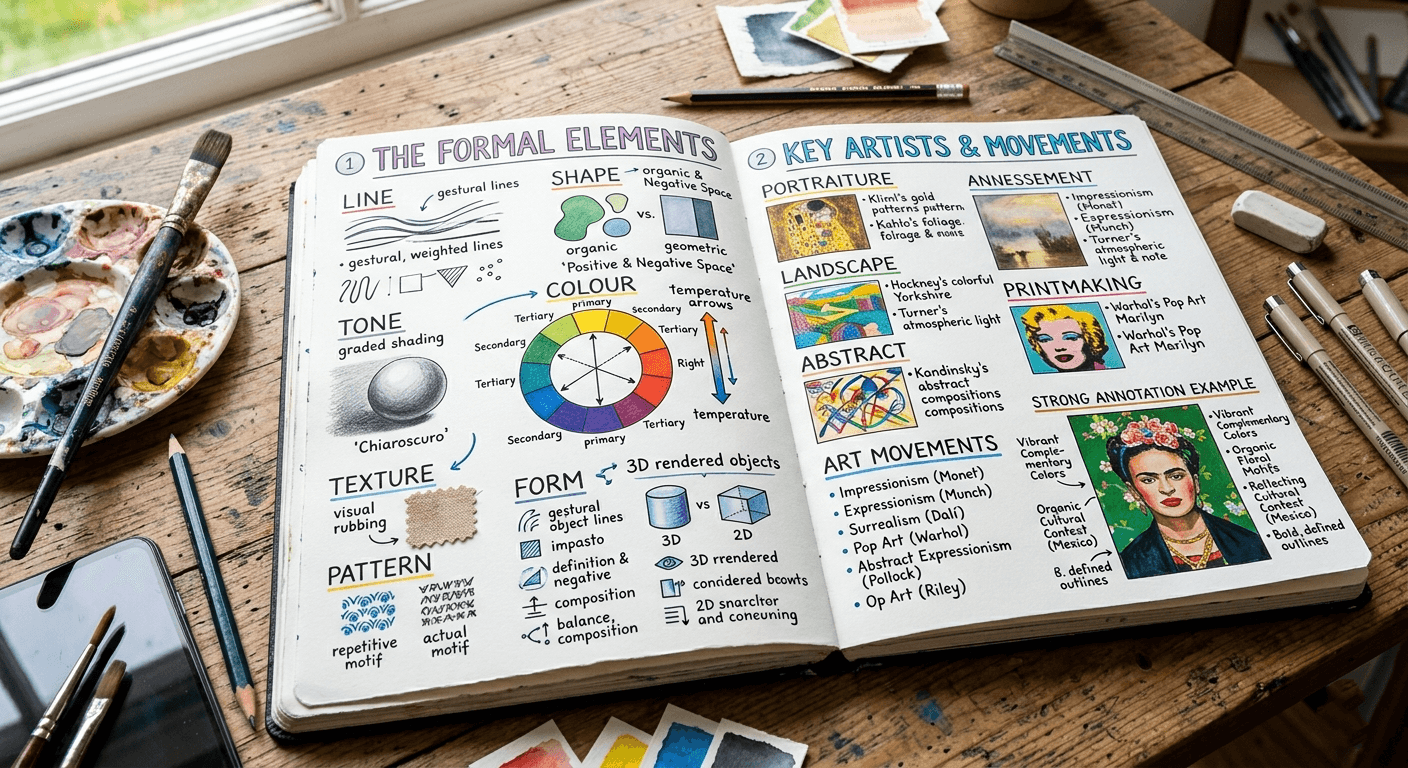
The 5 Knowledge Areas Most Commonly Assessed at KS3
1. The Formal Elements of Art
These are the building blocks that artists, teachers, and examiners all use to talk about visual work. You need to know all seven and be able to apply them when discussing your own work or analysing someone else's.
Formal Element | What to know |
|---|---|
Line | Direction, weight, quality — contour vs gestural vs geometric |
Shape | Geometric vs organic; positive and negative space |
Tone | Light and shadow; how tone creates form and depth |
Colour | Hue, saturation, temperature; colour theory (primary, secondary, complementary, analogous) |
Texture | Visual vs actual texture; how artists suggest surface quality |
Pattern | Repetition, rhythm, motif |
Form | Three-dimensional quality; how 2D work implies 3D form |
In assessments: Annotation tasks almost always ask you to comment on at least two or three formal elements. Students who know these terms precisely — and can explain why an artist has used them, not just that they have — consistently score higher.
2. Key Artists and Movements
You don't need to know every artist in history. You need a small, well-understood set that you can discuss with confidence. The artists most commonly studied at KS3 across UK schools include:
Portraiture and the human figure: Gustav Klimt, Frida Kahlo, Lucian Freud, Jenny Saville
Landscape and environment: J.M.W. Turner, Georgia O'Keeffe, David Hockney
Abstract and pattern-based work: Wassily Kandinsky, Bridget Riley, Mondrian
Printmaking and graphic art: Andy Warhol, Katsushika Hokusai, Lino-cut traditions
For each artist you study, be able to answer four questions: What period or movement are they from? What is distinctive about their style? Which formal elements do they use most strongly? How does their work connect to context — social, cultural, historical?
Common mistake: Writing about what an artwork looks like without saying how the artist achieved that effect or why it matters. "The painting uses bright colours" is a weak answer. "Klimt uses gold leaf and saturated complementary colours to create a sense of opulence connected to the Viennese Art Nouveau movement" is a strong one.
3. Art Movements and Their Context
Understanding when and why art movements emerged helps you write more convincing analysis. The movements most often covered at KS3:
Impressionism (late 19th century France) — responding to photography and industrialisation; capturing light and moment rather than detail. Key artists: Monet, Renoir, Degas.
Expressionism (early 20th century Germany) — prioritising emotional truth over visual accuracy; bold distortion and colour. Key artists: Munch, Kirchner, Kandinsky.
Surrealism (1920s–30s) — drawing on dreams and the unconscious; unexpected combinations of objects. Key artists: Dalí, Magritte, Kahlo.
Pop Art (1950s–60s UK and USA) — responding to mass media, advertising, and consumer culture. Key artists: Warhol, Lichtenstein, Hamilton.
Abstract Expressionism (post-war USA) — gesture, scale, and the physical act of painting. Key artists: Pollock, Rothko, de Kooning.
Op Art (1960s) — optical illusions through pattern, line, and colour contrast. Key artists: Bridget Riley, Victor Vasarely.
4. Annotation Skills
Annotation is how you demonstrate understanding in Art and Design without a written exam. Most schools assess annotation as part of sketchbook or portfolio work throughout KS3.
Strong annotation does three things:
Describes — what you see, using formal element vocabulary
Analyses — how the artist made choices and what effect they create
Connects — links to context, influence, or your own developing work
Weak annotation: "I like this painting because it uses lots of colour and the figure looks realistic."
Strong annotation: "Freud applies thick, directional impasto brushwork to model the figure, building up tonal contrast rather than using line to define form. The result feels physically present rather than idealised — consistent with his stated interest in depicting the body honestly rather than beautifully."
The vocabulary matters. Build a bank of subject-specific terms you can use accurately: impasto, chiaroscuro, gestural, abstracted, tonal range, compositional balance, negative space, motif, juxtaposition.
5. Design Disciplines (not just Fine Art)
KS3 Art and Design includes design as well as fine art. Depending on your school, you may also be assessed on:
Graphic design: typography, layout, visual communication, branding
Textile design: pattern, surface decoration, cultural traditions in textiles
Product design / 3D design: form and function, materials, user-centred design thinking
Architecture: built environment, proportion, space
Even if your school focuses mainly on fine art, knowing the broader design landscape improves your contextual understanding and gives you more to draw on in written tasks.
How to Revise Art and Design Knowledge Effectively
Build an artist study card for each artist you've covered. One side: name, dates, movement, key works. Other side: three formal elements they use strongly, one sentence on context, one annotated image from memory.
Learn the formal elements until they're automatic. Practice applying them to images you've never seen before — pick any artwork and write three sentences using formal element vocabulary. This is exactly what annotation tasks require.
Don't revise from images alone. Art and Design revision is often passive — flipping through images without active recall. A quiz that asks you to name movements, identify formal elements, or complete partial artist descriptions forces you to retrieve knowledge rather than just recognise it.
Use your sketchbook. Your own annotation work is a revision resource. Re-read it actively — cover your notes, try to recall what you wrote about each artist or artwork, then check.
A 10-Minute KS3 Art and Design Revision Routine
Minutes 1–3: Go through your artist study cards. For each one, state the movement, one formal element, one contextual point — from memory.
Minutes 4–6: Pick one formal element. Write a short paragraph applying it to an artwork you've studied. Aim for at least three subject-specific terms.
Minutes 7–8: Sketch a quick compositional diagram of one artwork from memory. Label the formal elements you can identify.
Minutes 9–10: Take a short quiz. Retrieving knowledge under mild time pressure is more effective than any amount of re-reading.
The Questions KS3 Art Assessments Actually Ask
Across written assessments, annotation tasks, and oral presentations at KS3, these question types appear most often:
Identify and explain two formal elements used in this artwork.
How does this artist's work reflect the time or culture it was made in?
Compare the techniques used by two artists you have studied.
Annotate this image using subject-specific vocabulary.
Explain how your own work has been influenced by an artist you have researched.
Revision that prepares you for these specific question types — rather than general reading about art — is the most efficient use of your time.
Test Your KS3 Art and Design Knowledge
The quickest way to find out which areas are solid and which need more work is to take a quiz that mirrors the knowledge questions above.
Start the KS3 Art and Design Quiz on QuizLuna →
Questions cover formal elements, artist and movement knowledge, and annotation vocabulary — mapped to the five areas in this guide. Your results show exactly where to focus next.
See all KS3 subjects on QuizLuna → Art and Design is one of 12+ subjects available, all aligned to the KS3 national curriculum.