This guide covers exactly what Citizenship involves at Key Stage 3, the five knowledge areas most commonly assessed, and how to use a quiz to check what you actually know before your next test or end-of-year review.
What Is KS3 Citizenship?
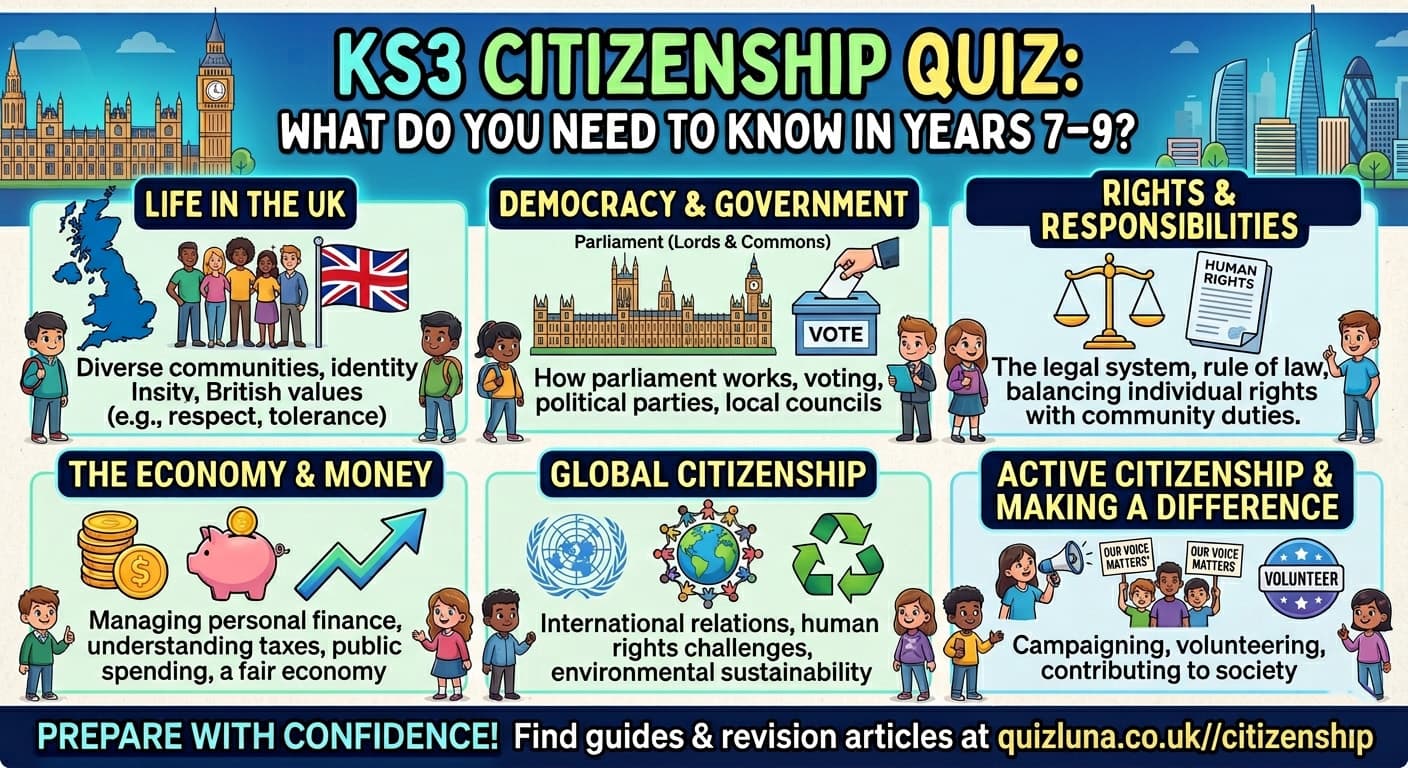
Citizenship is a statutory subject at Key Stage 3, which means all state schools in England must teach it. The national curriculum covers four broad areas:
Democracy and government — how the UK political system works
Rights and responsibilities — the law, human rights, and civic duties
The economy — personal finance, taxation, and how the economy functions
Identity and diversity — what it means to be a citizen in a diverse society
Unlike most subjects, Citizenship is explicitly about the real world. The knowledge you learn applies directly to how your country is run, what rights you have, and how you can participate as a citizen. That makes it both more relevant and more assessable than students often expect.
The 5 Topics Most Commonly Assessed at KS3
1. How UK Democracy Works
Democracy means government by the people — but the details matter in assessments. You need to understand the structures, not just the concept.
Parliament:
The UK Parliament has two chambers: the House of Commons (elected MPs) and the House of Lords (appointed members)
Laws begin as Bills, pass through multiple readings in both Houses, then receive Royal Assent to become Acts of Parliament
General elections use the First Past the Post system — the candidate with the most votes in each constituency wins
Government vs Parliament: This distinction catches students out. Parliament makes laws. The Government (Prime Minister and Cabinet) runs the country day-to-day. The Government must have the confidence of Parliament to remain in power.
Local government: Local councils handle services including education, planning, waste, and social care. Local councillors are elected separately from MPs.
Key terms to know: constituency, MP, manifesto, debate, legislation, scrutiny, devolution, referendum
Common mistake: Confusing the role of the monarch with the role of elected government. The UK is a constitutional monarchy — the monarch's powers are largely ceremonial; real power lies with elected politicians.
2. Rights, Responsibilities, and the Law
This is the most content-heavy area of KS3 Citizenship and the one where precise knowledge pays off most in assessments.
Human rights: The Human Rights Act 1998 incorporates the European Convention on Human Rights into UK law. Key rights include the right to life, the right to a fair trial, freedom of expression, and freedom from torture. Rights can sometimes be limited — the right to free expression, for example, does not protect hate speech.
The legal system:
Criminal law deals with offences against society (theft, assault, fraud). The state prosecutes.
Civil law deals with disputes between individuals or organisations (contracts, negligence, family disputes).
The age of criminal responsibility in England and Wales is 10 years old.
Youth courts handle cases involving defendants aged 10–17.
Rights and responsibilities: Citizenship assessment often asks students to explain that rights come with corresponding responsibilities. The right to vote comes with the responsibility to make an informed choice. The right to free expression comes with the responsibility not to incite hatred or harm.
Key terms to know: human rights, civil liberties, legislation, prosecution, defendant, magistrate, judiciary, rule of law, age of criminal responsibility
3. Democracy in Action — Voting, Elections, and Participation
Understanding how citizens participate in democracy goes beyond elections. KS3 assessments often ask about the different ways people can influence political decisions:
Formal participation:
Voting in local, national, and devolved elections
Standing as a candidate
Contacting your MP
Active citizenship:
Petitions (a UK government petition with 100,000+ signatures triggers a parliamentary debate)
Pressure groups and campaigning
Trade unions
Volunteering and community action
Journalism and media
Why participation matters: Low voter turnout is a genuine political issue in the UK — especially among younger age groups. Citizenship curriculum explores why people don't participate and what consequences that has for democracy.
Key terms to know: voter turnout, petition, pressure group, lobbying, direct democracy, representative democracy, devolution
4. The Economy and Personal Finance
This area is less conceptually difficult but requires specific knowledge that students often skip.
How the economy works:
GDP (Gross Domestic Product): the total value of goods and services produced in a country — used as a measure of economic health
Taxation: Income tax, National Insurance, VAT, and corporation tax are the main taxes in the UK. Taxes fund public services.
Public spending: The government decides how tax revenue is allocated — NHS, education, defence, welfare, infrastructure
Inflation: When prices rise over time, the purchasing power of money falls. The Bank of England sets interest rates partly to control inflation.
Personal finance:
Understanding payslips: gross pay vs net pay, deductions for tax and National Insurance
Budgeting: income vs expenditure
Types of borrowing: overdrafts, loans, credit cards — and the concept of interest
Common mistake: Students often describe tax as money "taken" from people rather than explaining it as the mechanism that funds collective services. Assessments reward the more nuanced explanation.
5. Identity, Diversity, and Global Citizenship
This topic is assessed less through factual recall and more through reasoned argument — but background knowledge still helps.
Key concepts:
National identity vs cultural identity: What does it mean to be British? Identity is multi-layered and not fixed.
Protected characteristics: Under the Equality Act 2010, nine characteristics are protected from discrimination: age, disability, gender reassignment, marriage and civil partnership, pregnancy and maternity, race, religion or belief, sex, and sexual orientation.
Global interdependence: Countries are economically, politically, and environmentally connected. International organisations like the UN, WHO, and World Trade Organisation manage shared challenges.
Sustainable development: The idea that meeting current needs should not compromise the ability of future generations to meet theirs — linked to climate policy and the UN Sustainable Development Goals.
In assessments: Questions on this topic often ask you to argue a position, evaluate a viewpoint, or explain multiple perspectives. Knowing the key terms and concepts gives you the vocabulary to write a more precise, convincing answer.
Citizenship Vocabulary You Must Know
A significant proportion of marks in written Citizenship assessments go to students who use subject-specific vocabulary accurately. Build these into your revision:
Political system: democracy, parliament, constituency, manifesto, legislation, devolution, referendum, coalition, scrutiny
Rights and law: human rights, civil liberties, rule of law, judiciary, prosecution, defendant, criminal law, civil law, legislation
Economy: GDP, taxation, inflation, public spending, fiscal policy, interest rate, gross pay, net pay
Society: protected characteristic, discrimination, equality, diversity, identity, pressure group, lobbyist, civil society
How to Revise Citizenship Effectively
Use the "define → explain → example" method. For every key term, practise: defining it in one sentence, explaining why it matters, and giving a real example. This is exactly the structure that gets marks in assessment answers.
Example: Democracy → Government where power comes from the people, typically through free elections → The UK holds general elections every five years in which all adults aged 18+ can vote for their local MP.
Follow current events — briefly. Citizenship is the one subject where reading a news headline genuinely helps your understanding. You don't need to read in depth — knowing that a bill is passing through Parliament, or that a recent court case tested a human rights law, gives you real-world examples to use in assessments.
Don't ignore the economy section. It's dry, but tax, GDP, and public spending questions appear in assessments regularly and are answerable with a small amount of precise knowledge. Ten minutes on this section is high-return revision.
Quiz yourself on terminology. The biggest gap between students who score well and those who don't is vocabulary precision. A quiz that tests whether you know what "devolution" means, or can explain the difference between criminal and civil law, is more effective than re-reading your notes.
A 10-Minute KS3 Citizenship Revision Routine
Minutes 1–3: Pick one topic area. Write down five key terms from memory and define each in one sentence.
Minutes 4–6: Choose one concept you find difficult (the difference between Parliament and Government, for example, or how a Bill becomes law). Write a short explanation as if teaching it to someone who knows nothing about it.
Minutes 7–8: Find a current news story that connects to Citizenship — an election, a court ruling, a budget announcement. Write two sentences explaining which topic area it connects to and why.
Minutes 9–10: Take a quiz. Active recall under time pressure builds the kind of quick retrieval that assessments require.
Test Your KS3 Citizenship Knowledge
The fastest way to find out which areas you know well — and which need work — is to test retrieval, not recognition.
Start the KS3 Citizenship Quiz on QuizLuna →
Questions cover all five topic areas above: democracy, rights and law, participation, the economy, and identity. Your results show exactly where to focus your next revision session.
See all KS3 subjects on QuizLuna → Citizenship is one of 12+ subjects available, all aligned to the KS3 national curriculum.
Last updated: May 2026 · Based on the KS3 Citizenship national curriculum and common Year 7–9 schemes of work used in UK secondary schools.