What Is Fast French at KS3?
Fast French is a structured approach to French revision used widely in UK secondary schools for Years 7, 8, and 9. Rather than re-reading notes, it focuses on rapid-fire recall — short bursts of vocabulary, grammar rules, and sentence patterns tested repeatedly until they become automatic.
The method works because it mirrors how French assessments are structured: you need to retrieve knowledge quickly, not just recognise it when you see it.
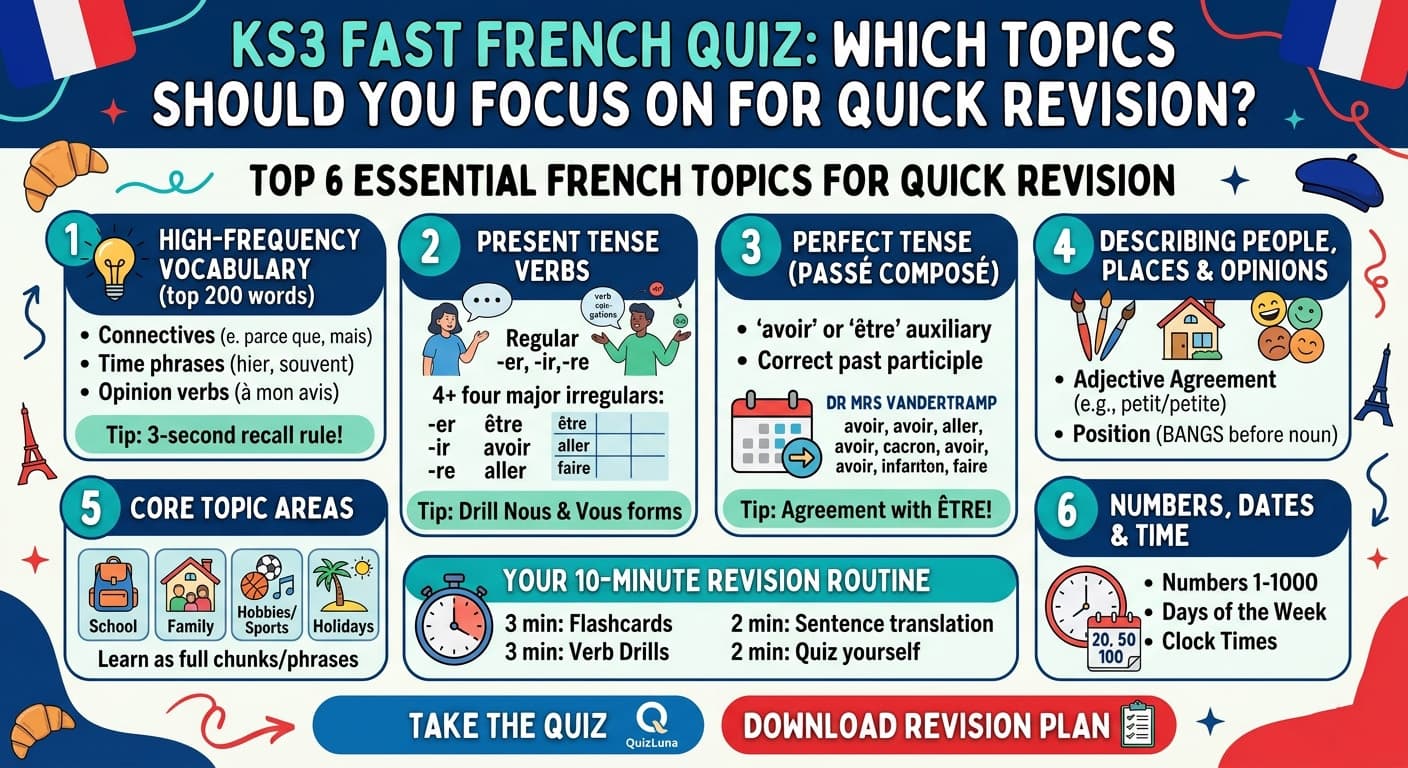
The 6 Topics That Come Up Most at KS3
Not all French topics carry equal weight. Based on the KS3 national curriculum and common school schemes of work, these six areas appear most frequently in assessments and form the backbone of any effective Fast French revision plan.
1. High-Frequency Vocabulary (the top 200 words)
A small set of French words accounts for the majority of what you'll read and write at KS3. Prioritise these over obscure vocabulary lists:
Connectives: parce que, mais, donc, cependant, bien que
Time phrases: hier, maintenant, demain, souvent, quelquefois
Opinion verbs: je pense que, je crois que, à mon avis
Quick test yourself: Cover one column of your vocabulary list and translate each word in under 3 seconds. If you hesitate, it goes back on the list.
2. Present Tense — Regular and Irregular Verbs
The present tense is the most tested tense at KS3. You need both regular patterns (-er, -ir, -re) and the key irregulars cold:
Verb | Je | Tu | Il/Elle | Nous | Vous | Ils/Elles |
|---|---|---|---|---|---|---|
être | suis | es | est | sommes | êtes | sont |
avoir | ai | as | a | avons | avez | ont |
aller | vais | vas | va | allons | allez | vont |
faire | fais | fais | fait | faisons | faites | font |
Common mistake: Students often mix up nous allons and vous allez under pressure. Drill the nous/vous distinction specifically.
3. The Perfect Tense (Passé Composé)
At Year 8 and 9 level, writing about the past is expected in almost every piece of extended writing. The passé composé requires three things:
The correct auxiliary verb (avoir or être)
The correct past participle
Agreement rules for être verbs
The 17 "DR MRS VANDERTRAMP" verbs take être as auxiliary. Learning this list saves marks in every writing task.
Most missed rule: Past participle agreement with être verbs. "Elle est allée" not "Elle est allé" — the extra -e costs marks and is easily fixed with practice.
4. Describing People, Places, and Opinions
Descriptive language with accurate adjective agreement is a reliable way to access higher marks at KS3. The two areas students most often lose marks on:
Adjective position (most go after the noun, but BANGS adjectives go before)
Gender agreement: un livre intéressant vs une histoire intéressante
Keep a short bank of 10 strong adjectives with both masculine and feminine forms memorised — this gives you flexible building blocks for any writing task.
5. School, Family, and Hobbies — the Core Topic Areas
KS3 assessments cluster around a predictable set of themes. The most commonly assessed are:
School life: subjects, opinions, timetable, school rules
Family: descriptions, relationships, home life
Free time: sports, music, social activities, technology
Holidays and travel: transport, accommodation, weather
Fast French revision for these topics means learning topic-specific phrases as complete chunks, not individual words. "Je m'entends bien avec mon frère" is more useful memorised whole than broken into parts.
6. Numbers, Dates, and Time
These appear in listening and reading tasks constantly but are under-revised. Students who practise numbers to 1000, days, months, and clock times regularly perform significantly better on listening assessments where there is no second chance to hear a piece of information.
A 10-Minute Fast French Revision Routine
You don't need hours. A consistent 10-minute routine beats a single long session.
Minutes 1–3: Flashcard recall Go through 20 vocabulary cards (digital or paper). Anything you hesitate on goes into a separate "retry" pile.
Minutes 4–6: Verb conjugation drill Pick one verb. Write out all six persons from memory. Check. Repeat with a second verb.
Minutes 7–8: Translate two sentences Write two sentences about yourself using the topic you're currently studying. Aim to include a past tense and an opinion phrase.
Minutes 9–10: Quiz yourself This is where a structured quiz pays off. Rather than rereading your notes, test retrieval with short questions that mirror the format of your actual assessments.
The Most Common KS3 French Mistakes (and How to Fix Them)
These come up in assessments repeatedly:
Forgetting the negative sandwich Ne…pas must wrap around the verb: Je ne mange pas de viande. Students often write Je ne mange de viande pas under pressure.
Using the wrong gender with new vocabulary Every noun has a gender. Learning it as le/la/un/une + word from the start avoids errors later. Don't learn chien — learn un chien.
Translating English structure directly into French French word order differs from English, especially for questions, negatives, and sentences with object pronouns. When in doubt, learn sentence patterns whole rather than constructing them from scratch.
Spelling mistakes on common words Beaucoup, aujourd'hui, maintenant — these lose marks in writing even when students know what they mean. Spelling should be part of your fast recall drills, not treated separately.
What to Do Before Your Next French Assessment
A week before: identify your two weakest topic areas from the list above and focus revision time there.
Three days before: do timed verb conjugation and vocabulary drills daily. Ten minutes is enough if it's genuinely timed and you're testing recall, not recognition.
The day before: do one complete quiz under exam conditions. Don't revise new material — consolidate what you already know.
Ready to Test Yourself?
The fastest way to find out which topics you actually know — and which ones only feel familiar — is to take a quiz that tests retrieval, not recognition.
Start the KS3 Fast French Quiz on QuizLuna →
Questions are mapped to the topic areas above, so your results tell you exactly where to focus next. No login required.
Last updated: May 2026. Content reflects the KS3 Modern Foreign Languages national curriculum and common Year 7–9 French schemes of work.