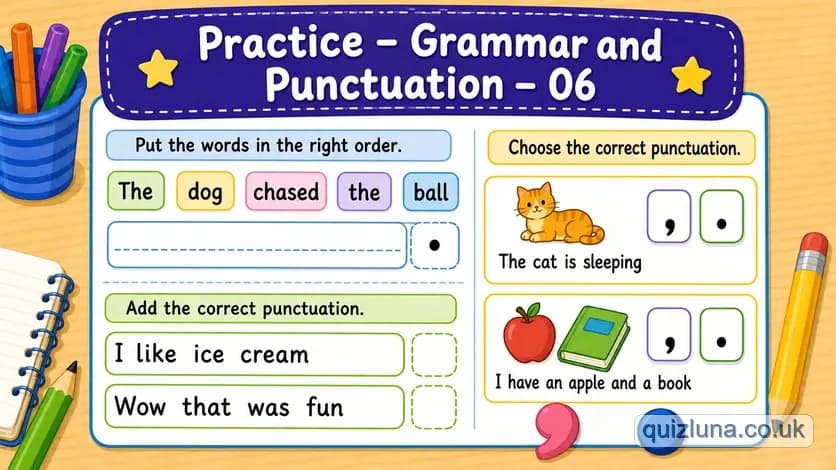
KS1 English Quiz: Grammar and Punctuation 6 | Key Stage 1
Keep practice focused with a KS1 English quiz on Grammar and Punctuation 6, giving pupils a simple route from recognition to better use.
Overview
- - Improve speed
- - Build confidence
- - Prepare for assessments
Quiz details
Topic: 06
Questions: 2
Duration: 10 min
Difficulty: ★★ Medium
Focus: applying 06 with consistent method and answer precision.
Related Quizzes
Description
Strengthen sentence accuracy with another round of KS1 punctuation practice
Children benefit from seeing grammar and punctuation more than once, in slightly different forms and in slightly different contexts. That is why a follow-up practice quiz can be so helpful. Instead of relying on memory from a single lesson, pupils revisit the same family of skills and deepen their confidence. On this KS1 English page, the aim is to help learners recognise the patterns that make writing easier to read and easier to understand.
Early grammar work matters because it supports both reading and writing. When a child can see where a sentence starts and stops, they are better prepared to read aloud with expression, to answer comprehension questions and to organise their own ideas on paper. The Department for Education National Curriculum places clear importance on basic punctuation and sentence awareness in Key Stage 1 because these are the foundations that later writing depends on.
Evidence for regular review is strong. The Education Endowment Foundation reports that oral language approaches are associated with roughly 6 additional months of progress, and reading comprehension approaches are also associated with around 6 additional months. Discussion around quiz answers can therefore be as valuable as the score itself, especially when children explain what was wrong and how they corrected it.
Why repeated punctuation practice helps
Some pupils can answer a grammar question correctly when prompted but still miss the same feature in their own independent writing. Repetition with variation helps solve that problem. A second or third quiz gives children another chance to identify rules quickly, compare examples and build fluency rather than relying on luck.
This matters for parents and teachers because small uncertainties often hide inside otherwise neat work. A child may know full stops, capital letters and question marks individually, but may not yet apply them automatically. Practice quizzes help turn separate facts into habits.
- Checking sentences before moving on too quickly
- Recognising punctuation patterns in familiar examples
- Improving accuracy in short written answers
- Preparing for broader KS1 English tasks
| Practice habit | Benefit |
|---|---|
| Complete one short quiz | Keeps revision manageable |
| Review every wrong answer | Turns mistakes into learning points |
| Read a corrected sentence aloud | Links punctuation to meaning and rhythm |
In KS1, accuracy grows fastest when children are taught to slow down and notice meaning. Punctuation is not only a writing rule; it is a reading clue.
Attributed to a primary English consultant.
How this quiz fits into a wider revision routine
Use this page as part of a short cycle: quiz, review, explain, and then write one or two example sentences independently. That final step matters because it helps children transfer recognition into real writing. Even a five-minute follow-up activity can make the practice more memorable.
Citations
Department for Education, National Curriculum in England: English programmes of study
Education Endowment Foundation, Teaching and Learning Toolkit: Oral language interventions; Reading comprehension strategies
This quiz works best when it is used regularly rather than only once. Short, repeated grammar and punctuation review gives children a steadier path to secure writing habits.
Related links: KS1 English quizzes, Capital letters and full stops, Book titles
Quiz reviews
Approved reviews are shown publicly on this page. New or updated reviews stay hidden until moderation is complete.
0.0
0 reviews
average rating
Leave a review
Reviews are limited to logged-in users so public ratings stay tied to real accounts and can be moderated cleanly.
Log in to reviewQuiz FAQ
How should I use this KS1 English Quiz: Grammar and Punctuation 6 | Key Stage 1?
Complete the quiz once under normal timing, review every mistake, then return to the English subject page to try a related quiz while the topic is still fresh.
What should I do after finishing this KS1 English Quiz: Grammar and Punctuation 6 | Key Stage 1?
Use your score as a signal. If the result is strong, move to another English quiz for wider coverage. If the result is weak, repeat practice in the same subject before switching topics.
Is KS1 English Quiz: Grammar and Punctuation 6 | Key Stage 1 enough on its own for English revision?
One quiz is useful for diagnosis, but not enough on its own. The strongest approach is to combine this page with other quizzes in English, plus broader revision or past-paper style practice where available.